IIT JEE 2012- Indian Institute of Technology - Joint Entrance Examination is an Entrance Exam conducted by Indian Institute of Technology for admission to Undergraduate Courses in fifteen IITs located in Bhubaneswar, Chennai, Delhi, Gandhinagar, Guwahati, Hyderabad, Indore, Jodhpur, Kanpur, Kharagpur, Mandi, Mumbai, Patna, Ropar and Roorkee, Institute of Technology, Banaras Hindu University (IT-BHU) Varanasi and Indian School of Mines (ISM) Dhanbad.
IIT JEE 2012 Online Application Registration you can check out websites :-
1. IIT JEE 2012 Online Application Registration
2. IIT JEE 2012 Online Application Registration
Welcome to IIT JEE 2012 Exam Section of entranceexamresults.co.in. In this section of IIT JEE 2012, you will find Syllabus of IIT JEE Entrance Exam 2012, IIT JEE 2012 Exam Date, Notification, Syllabus, Preparation, Paper Pattern, Sample Test Papers, Questions, IIT JEE Exam Dates, Online IIT JEE Test and IIT JEE Results.
From 2012 onwards Indian Institutes of Technology (IITs) propose to return to the old system of screening aspirants at two levels to weed out “unmanageable” candidates taking the exam every year. For the final entry to the technical institutes, aspirants who clear the first level of screening- comprising Class XII board exams and national aptitude test – would have to write an exam featuring long questions that demand reasoning ability from the students.
The government recently announced that only those students who secured first class (60 per cent) in plus two exam will be eligible for admission to the IITs (however there is relaxation of 5 per cent for SC/ST students).
As per the decision the students will get only two attempts – the year of clearing plus two examinations and the following year – to appear in JEE test.
IIT JEE 2012 Paper Pattern:-
There will be two question papers, each of three hours duration. Both the question papers will consist of three separate sections on Chemistry, Physics and Mathematics. They will be of objective type, designed to test comprehension, reasoning and analytical ability of candidates.
The answers for each of the questions are to be recorded on a separate, specially designed, machine-gradable sheet of paper (ORS Optical Response Sheet). While answering each of the questions the candidate is expected to darken the bubble(s) against correct answer(s) using hard black (HB) pencils only. In some sections, incorrect answers may be awarded negative marks.
IIT JEE 2012 Eligibility:-
The candidate must have passed their 10+2 examinations from a recognized board.
The candidates who will be giving their final examinations of 10+2 in 2011 are also eligible to apply.
IIT JEE 2012 Notification / Important Dates:-
Start of Online application process:- Monday October 31, 2011
Closing of Online application process:- Saturday, December 10, 2011
IIT-JEE 2012 examination day:- Sunday, April 8, 2012
Declaration of Results:- Friday, May 18, 2012.
IIT JEE 2012 Syllabus:-
The best time to start IIT JEE preparation is at the beginning of 11th class. Students are fresh after the break after boards and a lot more can be learnt. Students who start late often end up leaving some key topics of 11th class JEE syllabus. Also, if you start your preparation in 12th class then the amount of hard work is increased manifold due to additional pressure of 12th boards, so chances of getting a high rank in JEE are decreased. There is a big transition from the mugging up study of 10th class to more understanding based study of 11th class. So you shouldn't get bogged down by seeing the level of complexity in JEE exam.
IIT JEE Chemistry Syllabus 2012:-
Physical chemistry:-
General topics: Concept of atoms and molecules; Dalton;s atomic theory; Mole concept; Chemical formulae; Balanced chemical equations; Calculations (based on mole concept) involving common oxidation-reduction, neutralisation, and displacement reactions; Concentration in terms of mole fraction, molarity, molality and normality.
Gaseous and liquid states: Absolute scale of temperature, ideal gas equation; Deviation from ideality, van der Waals equation; Kinetic theory of gases, average, root mean square and most probable velocities and their relation with temperature; Law of partial pressures; Vapour pressure; Diffusion of gases.
Atomic structure and chemical bonding:Â Bohr model, spectrum of hydrogen atom, quantum numbers; Wave-particle duality, de Broglie hypothesis; Uncertainty principle; Qualitative quantum mechanical picture of hydrogen atom, shapes of s, p and d orbitals; Electronic configurations of elements (up to atomic number 36); Aufbau principle; Pauli's exclusion principle and Hund's rule; Orbital overlap and covalent bond; Hybridisation involving s, p and d orbitals only; Orbital energy diagrams for homonuclear diatomic species;Â Hydrogen bond; Polarity in molecules, dipole moment (qualitative aspects only); VSEPR model and shapes of molecules (linear, angular, triangular, square planar, pyramidal, square pyramidal, trigonal bipyramidal, tetrahedral and octahedral).
Energetics: First law of thermodynamics; Internal energy, work and heat, pressure-volume work; Enthalpy, Hess's law; Heat of reaction, fusion and vapourization; Second law of thermodynamics; Entropy; Free energy; Criterion of spontaneity.
Chemical equilibrium: Law of mass action; Equilibrium constant, Le Chatelier;s principle (effect of concentration, temperature and pressure); Significance of ΔG and ΔG° in chemical equilibrium; Solubility product, common ion effect, pH and buffer solutions;  Acids and bases (Bronsted and Lewis concepts); Hydrolysis of salts.
Electrochemistry: Electrochemical cells and cell reactions; Standard electrode potentials; Nernst equation and its relation to ΔG; Electrochemical series, emf of galvanic cells; Farada's laws of electrolysis; Electrolytic conductance, specific, equivalent and molar conductivity, Kohlrausch's law; Concentration cells.
Chemical kinetics:Â Rates of chemical reactions; Order of reactions; Rate constant; First order reactions; Temperature dependence of rate constant (Arrhenius equation).
Solid state: Classification of solids, crystalline state, seven crystal systems (cell parameters a, b, c, α, β, γ), close packed structure of solids (cubic), packing in fcc, bcc and hcp lattices; Nearest neighbours, ionic radii, simple ionic compounds, point defects.
Solutions:Â Raoult's law; Molecular weight determination from lowering of vapour pressure, elevation of boiling point and depression of freezing point.
Surface chemistry:Â Elementary concepts of adsorption (excluding adsorption isotherms); Colloids: types, methods of preparation and general properties; Elementary ideas of emulsions, surfactants and micelles (only definitions and examples).
Nuclear chemistry: Radioactivity: isotopes and isobars; Properties of α, β and γ rays; Kinetics of radioactive decay (decay series excluded), carbon dating; Stability of nuclei with respect to proton-neutron ratio; Brief discussion on fission and fusion reactions.
Inorganic Chemistry:-
Isolation/preparation and properties of the following non-metals: Boron, silicon, nitrogen, phosphorus, oxygen, sulphur and halogens; Properties of allotropes of carbon (only diamond and graphite), phosphorus and sulphur.
Preparation and properties of the following compounds: Oxides, peroxides, hydroxides, carbonates, bicarbonates, chlorides and sulphates of sodium, potassium, magnesium and calcium; Boron: diborane, boric acid and borax; Aluminium: alumina, aluminium chloride and alums; Carbon: oxides and oxyacid (carbonic acid); Silicon: silicones, silicates and silicon carbide;Â Nitrogen: oxides, oxyacids and ammonia; Phosphorus: oxides, oxyacids (phosphorus acid, phosphoric acid) and phosphine; Oxygen: ozone and hydrogen peroxide; Sulphur: hydrogen sulphide, oxides, sulphurous acid, sulphuric acid and sodium thiosulphate; Halogens: hydrohalic acids, oxides and oxyacids of chlorine, bleaching powder; Xenon fluorides.
Transition elements (3d series): Definition, general characteristics, oxidation states and their stabilities, colour (excluding the details of electronic transitions) and calculation of spin-only magnetic moment; Coordination compounds: nomenclature of mononuclear coordination compounds, cis-trans and ionisation isomerisms, hybridization and geometries of mononuclear coordination compounds (linear, tetrahedral, square planar and octahedral).
Preparation and properties of the following compounds: Oxides and chlorides of tin and lead; Oxides, chlorides and sulphates of Fe2+, Cu2+ and Zn2+; Potassium permanganate, potassium dichromate, silver oxide, silver nitrate, silver thiosulphate.
Ores and minerals: Commonly occurring ores and minerals of iron, copper, tin, lead, magnesium, aluminium, zinc and silver.
Extractive metallurgy: Chemical principles and reactions only (industrial details excluded); Carbon reduction method (iron and tin); Self reduction method (copper and lead); Electrolytic reduction method (magnesium and aluminium); Cyanide process (silver and gold).
Principles of qualitative analysis: Groups I to V (only Ag+, Hg2+, Cu2+, Pb2+, Bi3+, Fe3+, Cr3+, Al3+, Ca2+, Ba2+, Zn2+, Mn2+ and Mg2+); Nitrate, halides (excluding fluoride), sulphate and sulphide.
Organic Chemistry:-
Concepts: Hybridisation of carbon; Sigma and pi-bonds; Shapes of simple organic molecules; Structural and geometrical isomerism;Â Optical isomerism of compounds containing up to two asymmetric centres, (R,S and E,Z nomenclature excluded); IUPAC nomenclature of simple organic compounds (only hydrocarbons, mono-functional and bi-functional compounds); Conformations of ethane and butane (Newman projections); Resonance and hyperconjugation; Keto-enol tautomerism; Determination of empirical and molecular formulae of simple compounds (only combustion method); Hydrogen bonds: definition and their effects on physical properties of alcohols and carboxylic acids; Inductive and resonance effects on acidity and basicity of organic acids and bases; Polarity and inductive effects in alkyl halides; Reactive intermediates produced during homolytic and heterolytic bond cleavage;Â Formation, structure and stability of carbocations, carbanions and free radicals.
Preparation, properties and reactions of alkanes: Homologous series, physical properties of alkanes (melting points, boiling points and density); Combustion and halogenation of alkanes; Preparation of alkanes by Wurtz reaction and decarboxylation reactions.
Preparation, properties and reactions of alkenes and alkynes: Physical properties of alkenes and alkynes (boiling points, density and dipole moments); Acidity of alkynes; Acid catalysed hydration of alkenes and alkynes (excluding the stereochemistry of addition and elimination); Reactions of alkenes with KMnO4 and ozone; Reduction of alkenes and alkynes; Preparation of alkenes and alkynes by elimination reactions; Electrophilic addition reactions of alkenes with X2, HX, HOX (X=halogen) and H2O;Â Addition reactions of alkynes; Metal acetylides.
Reactions of benzene: Structure and aromaticity; Electrophilic substitution reactions: halogenation, nitration, sulphonation, Friedel-Crafts alkylation and acylation; Effect of o-, m- and p-directing groups in monosubstituted benzenes.
Phenols: Acidity, electrophilic substitution reactions (halogenation, nitration and sulphonation); Reimer-Tieman reaction, Kolbe reaction.
Characteristic reactions of the following (including those mentioned above): Alkyl halides: rearrangement reactions of alkyl carbocation, Grignard reactions, nucleophilic substitution reactions; Alcohols: esterification, dehydration and oxidation, reaction with sodium, phosphorus halides, ZnCl2/concentrated HCl, conversion of alcohols into aldehydes and ketones; Ethers:Preparation by Williamson’s Synthesis; Aldehydes and Ketones: oxidation, reduction, oxime and hydrazone formation; aldol condensation, Perkin reaction; Cannizzaro reaction; haloform reaction and nucleophilic addition reactions (Grignard addition); Carboxylic acids: formation of esters, acid chlorides and amides, ester hydrolysis; Amines: basicity of substituted anilines and aliphatic amines, preparation from nitro compounds, reaction with nitrous acid, azo coupling reaction of diazonium salts of aromatic amines, Sandmeyer and related reactions of diazonium salts; carbylamine reaction; Haloarenes: nucleophilic aromatic substitution in haloarenes and substituted haloarenes (excluding Benzyne mechanism and Cine substitution).
Carbohydrates: Classification; mono- and di-saccharides (glucose and sucrose); Oxidation, reduction, glycoside formation and hydrolysis of sucrose.
Amino acids and peptides: General structure (only primary structure for peptides) and physical properties.
Properties and uses of some important polymers: Natural rubber, cellulose, nylon, teflon and PVC.
Practical organic chemistry: Detection of elements (N, S, halogens); Detection and identification of the following functional groups: hydroxyl (alcoholic and phenolic), carbonyl (aldehyde and ketone), carboxyl, amino and nitro; Chemical methods of separation of mono-functional organic compounds from binary mixtures.
IIT JEE Mathemtics Syllabus 2012:-
Algebra: Algebra of complex numbers, addition, multiplication, conjugation, polar representation, properties of modulus and principal argument, triangle inequality, cube roots of unity, geometric interpretations.
Quadratic equations with real coefficients, relations between roots and coefficients, formation of quadratic equations with given roots, symmetric functions of roots.
Arithmetic, geometric and harmonic progressions, arithmetic, geometric and harmonic means, sums of finite arithmetic and geometric progressions, infinite geometric series, sums of squares and cubes of the first n natural numbers.
Logarithms and their properties.
Permutations and combinations, Binomial theorem for a positive integral index, properties of binomial coefficients.
Matrices as a rectangular array of real numbers, equality of matrices, addition, multiplication by a scalar and product of matrices, transpose of a matrix, determinant of a square matrix of order up to three, inverse of a square matrix of order up to three, properties of these matrix operations, diagonal, symmetric and skew-symmetric matrices and their properties, solutions of simultaneous linear equations in two or three variables.
Addition and multiplication rules of probability, conditional probability, Bayes Theorem, independence of events, computation of probability of events using permutations and combinations.
Trigonometry: Trigonometric functions, their periodicity and graphs, addition and subtraction formulae, formulae involving multiple and sub-multiple angles, general solution of trigonometric equations.
Relations between sides and angles of a triangle, sine rule, cosine rule, half-angle formula and the area of a triangle, inverse trigonometric functions (principal value only).
Analytical geometry:
Two dimensions: Cartesian coordinates, distance between two points, section formulae, shift of origin.
Equation of a straight line in various forms, angle between two lines, distance of a point from a line; Lines through the point of intersection of two given lines, equation of the bisector of the angle between two lines, concurrency of lines;Â Centroid, orthocentre, incentre and circumcentre of a triangle.
Equation of a circle in various forms, equations of tangent, normal and chord.
Parametric equations of a circle, intersection of a circle with a straight line or a circle, equation of a circle through the points of intersection of two circles and those of a circle and a straight line.
Equations of a parabola, ellipse and hyperbola in standard form, their foci, directrices and eccentricity, parametric equations, equations of tangent and normal.
Locus Problems.
Three dimensions: Direction cosines and direction ratios, equation of a straight line in space, equation of a plane, distance of a point from a plane.
Differential calculus: Real valued functions of a real variable, into, onto and one-to-one functions, sum, difference, product and quotient of two functions, composite functions, absolute value, polynomial, rational, trigonometric, exponential and logarithmic functions.
Limit and continuity of a function, limit and continuity of the sum, difference, product and quotient of two functions, Hospital rule of evaluation of limits of functions.
Even and odd functions, inverse of a function, continuity of composite functions, intermediate value property of continuous functions.
Derivative of a function, derivative of the sum,
difference, product and quotient of two functions, chain rule, derivatives of polynomial, rational, trigonometric, inverse trigonometric, exponential and logarithmic functions.
Derivatives of implicit functions, derivatives up to order two, geometrical interpretation of the derivative, tangents and normals, increasing and decreasing functions, maximum and minimum values of a function, Rolle's Theorem and Lagrange's Mean Value Theorem.
Integral calculus: Integration as the inverse process of differentiation, indefinite integrals of standard functions, definite integrals and their properties, Fundamental Theorem of Integral Calculus.
Integration by parts, integration by the methods of substitution and partial fractions, application of definite integrals to the determination of areas involving simple curves.
Formation of ordinary differential equations, solution of homogeneous differential equations, separation of variables method, linear first order differential equations.
Vectors: Addition of vectors, scalar multiplication, dot and cross products, scalar triple products and their geometrical interpretations.
IIT JEE Physics Syllabus 2012:-
General: Units and dimensions, dimensional analysis; least count, significant figures; Methods of measurement and error analysis for physical quantities pertaining to the following experiments: Experiments based on using Vernier calipers and screw gauge (micrometer), Determination of g using simple pendulum, Young's modulus by Searle's method, Specific heat of a liquid using calorimeter, focal length of a concave mirror and a convex lens using u-v method, Speed of sound using resonance column, Verification of Ohm's law using voltmeter and ammeter, and specific resistance of the material of a wire using meter bridge and post office box.
Mechanics: Kinematics in one and two dimensions (Cartesian coordinates only), projectiles; Uniform Circular motion; Relative velocity.
Newton's laws of motion; Inertial and uniformly accelerated frames of reference; Static and dynamic friction; Kinetic and potential energy; Work and power; Conservation of linear momentum and mechanical energy.
Systems of particles; Centre of mass and its motion; Impulse; Elastic and inelastic collisions.Â
Law of gravitation; Gravitational potential and field; Acceleration due to gravity; Motion of planets and satellites in circular orbits; Escape velocity.
Rigid body, moment of inertia, parallel and perpendicular axes theorems, moment of inertia of uniform bodies with simple geometrical shapes; Angular momentum; Torque; Conservation of angular momentum; Dynamics of rigid bodies with fixed axis of rotation; Rolling without slipping of rings, cylinders and spheres; Equilibrium of rigid bodies; Collision of point masses with rigid bodies.
Linear and angular simple harmonic motions.
Hooke's law, Young's modulus.
Pressure in a fluid; Pascal's law; Buoyancy; Surface energy and surface tension, capillary rise; Viscosity (Poiseuille's equation excluded), Stoke's law; Terminal velocity, Streamline flow, equation of continuity, Bernoulli's theorem and its applications.
Wave motion (plane waves only), longitudinal and transverse waves, superposition of waves; Progressive and stationary waves; Vibration of strings and air columns;Resonance; Beats; Speed of sound in gases; Doppler effect (in sound).
Thermal physics: Thermal expansion of solids, liquids and gases; Calorimetry, latent heat; Heat conduction in one dimension; Elementary concepts of convection and radiation; Newton's law of cooling; Ideal gas laws; Specific heats (Cv and Cp for monoatomic and diatomic gases); Isothermal and adiabatic processes, bulk modulus of gases; Equivalence of heat and work; First law of thermodynamics and its applications (only for ideal gases);Â Blackbody radiation: absorptive and emissive powers; Kirchhoff's law; Wien's displacement law, Stefan's law.
Electricity and magnetism: Coulomb-s law; Electric field and potential; Electrical potential energy of a system of point charges and of electrical dipoles in a uniform electrostatic field; Electric field lines; Flux of electric field; Gauss's law and its application in simple cases, such as, to find field due to infinitely long straight wire, uniformly charged infinite plane sheet and uniformly charged thin spherical shell.
Capacitance; Parallel plate capacitor with and without dielectrics; Capacitors in series and parallel; Energy stored in a capacitor.
Electric current; Ohm's law; Series and parallel arrangements of resistances and cells; Kirchhoff's laws and simple applications; Heating effect of current.
Biot Savart's law and Ampere's law; Magnetic field near a current-carrying straight wire, along the axis of a circular coil and inside a long straight solenoid; Force on a moving charge and on a current-carrying wire in a uniform magnetic field.
Magnetic moment of a current loop; Effect of a uniform magnetic field on a current loop; Moving coil galvanometer, voltmeter, ammeter and their conversions.
Electromagnetic induction: Faraday's law, Lenz's law; Self and mutual inductance; RC, LR and LC circuits with D.C. and A.C. sources.
Optics: Rectilinear propagation of light; Reflection and refraction at plane and spherical surfaces; Total internal reflection; Deviation and dispersion of light by a prism; Thin lenses; Combinations of mirrors and thin lenses; Magnification.Â
Wave nature of light: Huygen's principle, interference limited to Young's double-slit experiment.
Modern physics: Atomic nucleus; Alpha, beta and gamma radiations; Law of radioactive decay;Â Decay constant; Half-life and mean life; Binding energy and its calculation; Fission and fusion processes; Energy calculation in these processes.
Photoelectric effect; Bohr's theory of hydrogen-like atoms; Characteristic and continuous X-rays, Moseley's law; de Broglie wavelength of matter waves.
IIT JEE 2011 Results:-
IIT JEE 2011 Result on Wednesday, May 25, 2011
Check IIIT JEE 2011 Results click here




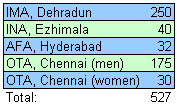 CDS (I) Exam 2012 Vacancies:



